How to Make a Nourishing Winter Hair Mask at Home.
Winter’s less-than-ideal conditions can leave your hair feeling compromised, but you don’t need salon-priced treatments to combat seasonal damage. The right combination of natural emollients, proteins, and humectants—ingredients you likely have in your kitchen—can restore your hair’s moisture barrier and structural integrity. Before you invest in expensive products, you’ll want to understand which active ingredients target specific winter hair concerns and how proper application techniques maximize their penetrative benefits.
Why Winter Weather Damages Your Hair
Winter’s harsh conditions create a perfect storm of damage mechanisms for your hair structure. Cold air strips moisture from your cuticles while indoor heating depletes humidity levels, causing brittleness and breakage.
Static electricity disrupts your hair’s natural protein bonds, leading to frizz and split ends. That’s why you’ll need a nourishing winter hair mask to restore essential lipids and strengthen compromised strands effectively.
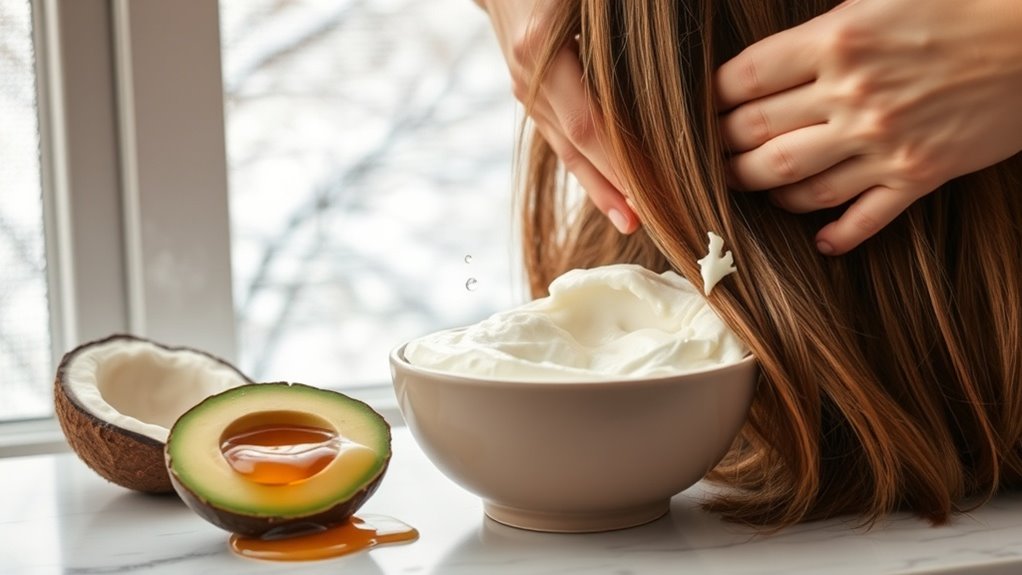
Natural ingredients like avocado, honey, and coconut oil can help repair this winter damage without expensive salon treatments.
Essential Ingredients for Effective Homemade Hair Masks
To formulate an effective winter hair mask, you’ll need to combine two critical ingredient categories that address moisture loss and structural damage.
Moisturizing oils and butters—such as coconut oil, shea butter, and argan oil—penetrate the hair shaft to restore lipid content and seal the cuticle against environmental stressors.
Protein-rich natural additives like eggs, Greek yogurt, and avocado reinforce the hair’s keratin structure, preventing breakage caused by cold weather brittleness.
For optimal results, combine 2 tablespoons coconut oil with 1 egg yolk to create a balanced treatment that addresses both moisture retention and protein fortification simultaneously.
Moisturizing Oils and Butters
Natural oils and butters form the foundation of effective hair masks because they penetrate the hair shaft to restore moisture balance and reinforce the lipid barrier. Select emollients based on your hair’s porosity:
- Coconut oil delivers deep conditioning through medium-chain fatty acids
- Argan oil provides lightweight hydration rich in vitamin E
- Shea butter seals cuticles and reduces breakage
- Jojoba oil mimics sebum for balanced moisture retention
Protein-Rich Natural Additives
While oils and butters address moisture deficiency, hair’s structural integrity depends on adequate protein content within the cortex. Incorporate hydrolyzed proteins like keratin or silk amino acids for molecular penetration.
You’ll achieve temporary fortification using egg whites, Greek yogurt, or gelatin—each containing protein molecules that bind to damaged cuticle sites. Apply these additives bi-weekly to prevent protein overload, which causes brittleness and breakage.
Avocado and Honey Deep Conditioning Treatment
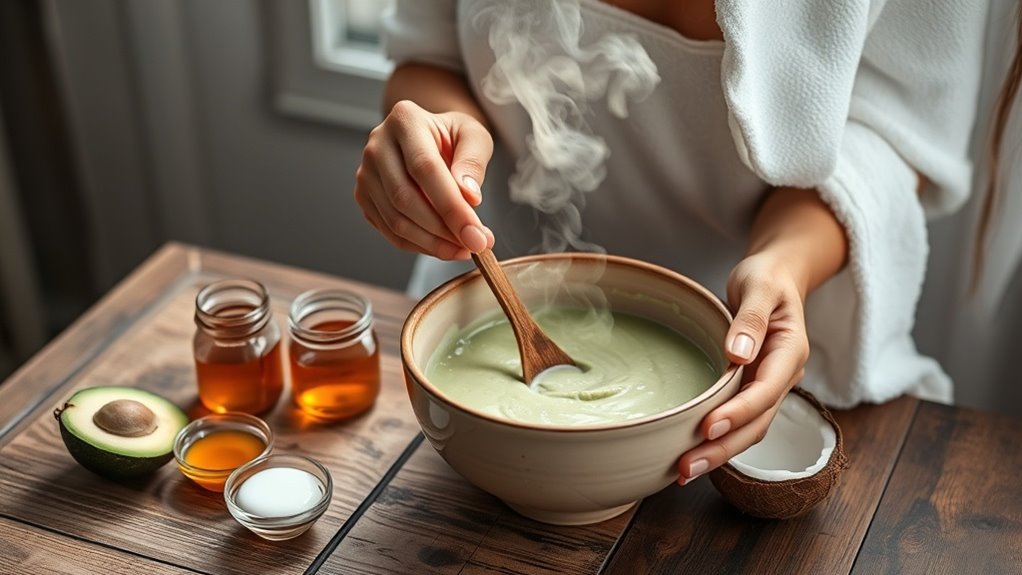
Avocado’s high concentration of oleic acid and natural emollients makes it an ideal base for penetrating the hair cuticle and restoring moisture to damaged strands. Honey acts as a humectant, drawing atmospheric moisture into the cortex.
To prepare this treatment:
- Mash one ripe avocado until completely smooth
- Incorporate two tablespoons raw honey
- Apply generously from mid-shaft to ends
- Process under heat for thirty minutes
For those experiencing winter hair damage, consider adding a tablespoon of coconut oil to boost the mask’s ability to prevent breakage and support healthier growth during cold weather months.
Coconut Oil and Egg Yolk Protein Mask
This protein-enriched treatment combines coconut oil’s medium-chain fatty acids with egg yolk’s naturally occurring keratin and biotin to reinforce the hair’s structural integrity. You’ll blend two tablespoons of warmed virgin coconut oil with one egg yolk until emulsified.
Apply from mid-shaft to ends, avoiding the scalp to prevent protein overload. Process for twenty minutes under a thermal cap, then rinse with cool water to prevent coagulation. Coconut oil’s ability to restore moisture makes it particularly effective during winter months when hair becomes dry and brittle.
Banana and Olive Oil Moisturizing Blend
For hair requiring intensive hydration without protein supplementation, banana’s natural humectants and potassium content work synergistically with olive oil’s oleic acid to restore moisture balance.
Application Protocol:
- Mash one ripe banana until completely smooth
- Incorporate two tablespoons extra virgin olive oil
- Apply mixture from mid-lengths to ends
- Process under heat for twenty minutes before rinsing thoroughly
Oatmeal and Yogurt Soothing Therapy
Sensitive scalps experiencing dryness or irritation benefit from colloidal oatmeal’s anti-inflammatory avenanthramides combined with yogurt’s lactic acid exfoliation properties.
Blend ½ cup ground oats with ¼ cup plain Greek yogurt until you’ve achieved a spreadable consistency. Apply to damp hair roots using sectioning techniques, massaging gently into your scalp. Leave for 20 minutes before rinsing thoroughly with lukewarm water to maintain moisture retention.
Application Tips and Best Practices for Maximum Results
Although winter hair masks contain potent nourishing ingredients, their efficacy depends largely on proper application methodology. You’ll maximize treatment absorption by:
- Pre-dampening hair strands with lukewarm water to open cuticles
- Sectioning hair into quadrants for thorough, even distribution
- Applying mask from mid-shaft to ends, avoiding scalp oversaturation
- Covering with a thermal cap for twenty-five minutes to enhance penetration